Jigsaw Drop: Solitaire Puzzle
- 4.6
- Rating
- 5.00M
- Installs
- Free
- Price
 Analysis by App-foxy
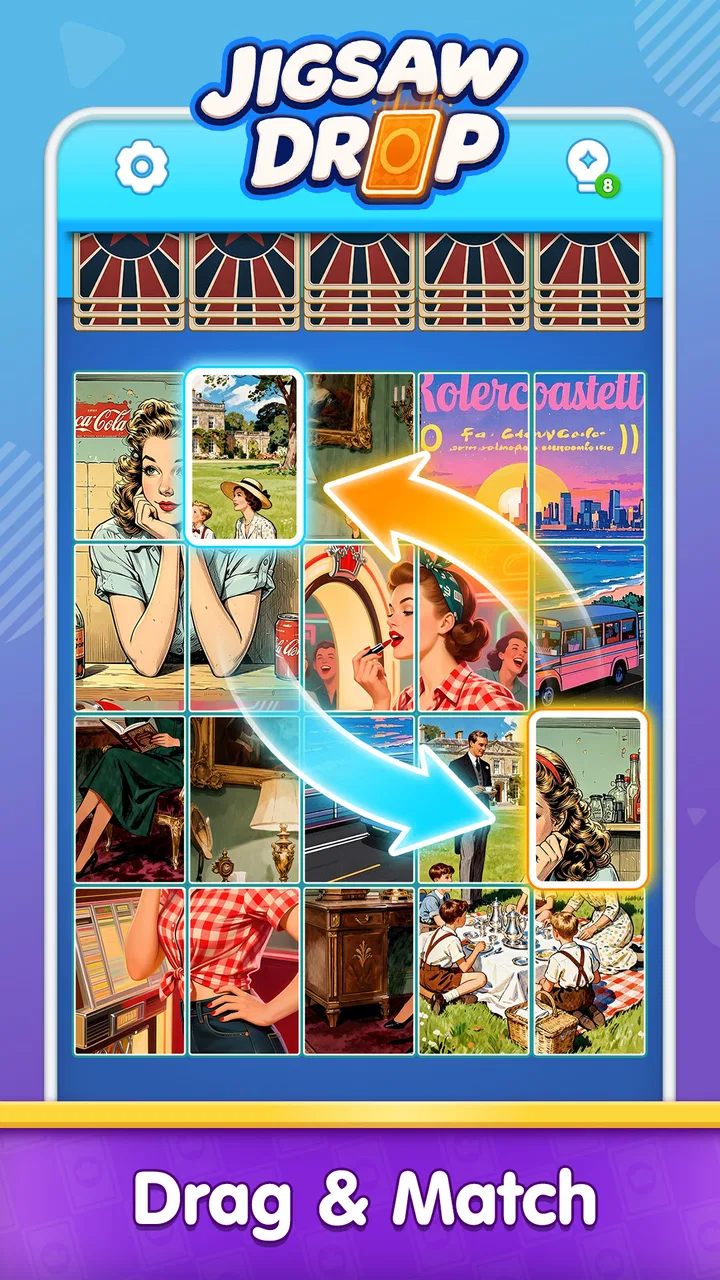
I spent my first sessions with Jigsaw Drop: Solitaire Puzzle expecting a small, disposable time-killer, but its appeal is more deliberate than that. It is a free puzzle game from Runyou built around matching pictures through simple, smooth moves. The presentation aims for calm rather than pressure, and that makes it easy to open when I want something quiet between tasks instead of another game demanding constant attention.
That first impression matters because this is not trying to replace a large strategy game or a traditional, carefully assembled jigsaw. Its strength is the short, low-friction puzzle session. I can understand the basic idea quickly, make progress without studying a manual, and stop without feeling that I have abandoned a complicated campaign. The important question, though, is whether that comfort survives after the novelty wears off. In my experience, the answer depends heavily on what I want from a puzzle game: relaxation and repetition suit it well, while deep variety and demanding problem-solving may lead me elsewhere.
Why the first week feels so approachable
The opening appeal comes from the combination of familiar picture matching and a lighter solitaire-like rhythm. Instead of asking me to build a physical puzzle piece by piece, the game turns the activity into a sequence of manageable decisions. I can focus on the visible arrangement, look for useful matches, and enjoy the small satisfaction of making the board cleaner. The smooth movement helps the interaction feel less tiring on a phone screen, especially when I am playing with one hand.
You May Also Like

 Blood Strike: 2.5 Anniversary
Blood Strike’s Loadouts Turn Every Drop Into a Tactical Gamble
A close look at Blood Strike’s custom loadouts: how fast access to signature weapons reshapes its battle royale rhythm, rewards preparation, and narrows the gap between fights.

 Pandora - Music & Podcasts
Pandora’s Music Is Easy to Start, but Harder to Recover
Pandora’s strength is its low-effort path from a seed to a station. Its weak spot is how much confidence it asks you to place in connection, setup, and quiet recovery.

 8 Ball Pool
 Is Built on Rivalries, Rematches, and Routine
A close look at the rivalries, rematches, shared routines, and unanswered safety questions that turn a quick pool match into a persistent mobile community.

 Samsung Music
’s Quiet Strength Is Playing What You Already Own
Its reach comes less from spectacle than from dependable access to a personal library. That simplicity is both the app’s strongest retention engine and its ceiling.

 AccuWeather: Weather Radar
AccuWeather Review: A Quick, Clear Forecast for Everyday Decisions
For everyday plans, the best forecast is the one you can understand quickly. AccuWeather makes rain timing, radar, and local conditions easy to act on, with a few trade-offs.

 Hill Climb Racing
Why Hill Climb Racing Still Turns Crashes Into One More Run
A tiny car, a bumpy hill and one more upgrade: Hill Climb Racing keeps resurfacing because its simple chaos makes every near-miss feel personal.
More From Our News Desk



I found the game particularly comfortable during small breaks. A few minutes while waiting for an appointment, winding down after work, or taking a pause from reading is enough to make a session worthwhile. There is no need to reserve a long block of time for it. That makes the game more practical than many puzzle titles that become frustrating when interrupted, because Jigsaw Drop: Solitaire Puzzle is built around a gentler pace and an easily understood objective.
The store presents it as a puzzle game for Everyone, and that description matches the approachable feel. I would be comfortable suggesting it to someone who does not normally play games, including a family member who prefers visual activities over fast action. The controls are not intimidating, and the picture-based format gives the game an immediate identity. It does not rely on complicated terminology to make the player feel involved.
Its early learning curve is one of its clearest strengths. I did not need to memorize a collection of special rules before enjoying the first rounds. That is useful for casual players, but it also creates the first long-term challenge: when the central interaction is easy to understand, lasting value must come from the quality and variation of the puzzles rather than from discovering a deep system.
One practical tip is to treat the first sessions as a test of mood, not skill. If I approach it expecting a relaxing visual routine, the game makes sense quickly. If I expect the complexity of a serious jigsaw simulator, I am likely to find the simplified structure too light. This distinction can save a potential player from judging it by the wrong standard.
The game has attracted a 4.7 average from around 9.4 thousand ratings, with more than 100 thousand installs. Those figures suggest that the accessible formula has found an audience, but they do not automatically mean it will suit every puzzle fan. I read them as evidence of a strong initial fit for people who value ease and calm, rather than as proof that the game offers endless depth.
A useful break rather than a demanding challenge
What I liked most during the first week was the absence of mental clutter. Some puzzle games add timers, complicated objectives, or several currencies until the board becomes secondary to management. Here, the picture-matching focus is easier to keep in view. I can play while mentally tired without feeling that I am failing at a system designed to overwhelm me.
That quality also makes it suitable for a specific everyday scenario: after finishing a long day, I might play a short round while waiting for tea to brew. I am not looking for a dramatic victory or a story reveal. I want a contained activity that occupies my attention for a moment and then lets me return to the evening. Jigsaw Drop: Solitaire Puzzle fits that use better than a competitive match or a large adventure game.
There is a trade-off, however. A low-pressure design can feel too forgiving for players who use puzzles to test concentration. If you prefer difficult spatial planning, strict time limits, or a clear sense of mastery, the first-week charm may fade sooner. A conventional jigsaw app with larger images and more control over piece count would probably be a better choice for that audience.
What remains useful after the novelty fades
Month-to-month value in a game like this is less about a single dramatic feature and more about whether the routine remains pleasant. I look for three things: whether starting a session still feels effortless, whether the visual activity continues to relax me, and whether the puzzles offer enough change to prevent every round from becoming automatic. Jigsaw Drop: Solitaire Puzzle performs best on the first two points.
The free price lowers the barrier to keeping it installed. I do not have to decide whether a short session has justified a purchase, which is important for a game I may open irregularly. It can sit on my phone and become a backup activity for quiet moments. That does not guarantee frequent use, but it makes returning easy when the mood is right.
The current version is 1.0.3, and the game was released on May 9, 2026. I mention those details because a relatively early version can shape expectations: I see this as a focused, developing puzzle experience rather than a mature platform with years of accumulated systems. For a player who wants a clean, uncomplicated pastime, that focus is positive. For someone choosing a game specifically for a huge amount of established content, it is a reason to remain cautious.
One of the more useful ways to preserve its value is to give it a role in a routine instead of opening it constantly out of habit. I might use it as a transition after work, a screen activity before bed, or a short reset between demanding tasks. When I play with that intention, the repetition feels soothing. When I open it automatically several times in a row, the simplicity becomes more noticeable and the experience loses some of its freshness.
This is an important distinction between recurring value and endless novelty. The game does not need to surprise me every time to be worthwhile. It can function like a quiet mental exercise, similar to sorting or arranging objects. But that means its value is personal and habitual. Players who need frequent rewards, new mechanics, or a strong progression arc may not find enough reason to return over many weeks.
I also think it works better as a companion game than as a phone’s only game. I would keep it alongside a more demanding puzzle title, a word game, or a longer adventure. Jigsaw Drop: Solitaire Puzzle fills the low-energy slot: something I can start immediately when I do not want to learn, compete, or commit. That role is narrower than being an all-purpose favorite, but it is a useful one.
How it compares with familiar puzzle alternatives
Compared with traditional digital jigsaws, this game is more convenient and less involved. A traditional format usually gives me greater control over pieces, image scale, and the feeling of reconstructing a complete scene. Jigsaw Drop: Solitaire Puzzle is better when I want quicker decisions and a more compact interaction. The trade-off is that it may not provide the same sense of ownership over the finished image.
Compared with match-three games, it feels calmer and less driven by chain reactions or rapid board changes. That makes it a stronger choice for players who find constant visual effects tiring. On the other hand, match-three games often provide a clearer sense of escalating challenge through special pieces and increasingly demanding boards. Someone seeking that rising intensity may prefer the alternative.
Compared with logic puzzles such as sudoku, it asks for a different kind of attention. Sudoku rewards deduction and sustained calculation, while this game is more visual and tactile. I would choose Jigsaw Drop when I want to settle my mind rather than exercise a strict reasoning method. If my goal is to sharpen numerical or logical concentration, sudoku remains the more suitable tool.
That comparison reveals the game’s most honest position. It is not the deepest puzzle experience in the usual sense; it is a soft, accessible interpretation of picture matching. Its recurring value comes from how comfortably it fits into a day, not from constantly expanding the definition of puzzle play.
Maintenance, friction, and reasons fatigue can appear
The maintenance burden is low in the practical sense. I do not need to organize a collection, learn a complicated control scheme, or remember a long chain of objectives. The game is easy to pick up after time away, which is valuable for anyone who plays in short bursts. A casual game that punishes a week of absence would work against its own purpose, and this one feels more forgiving.
Still, maintaining interest is different from maintaining the app. The main effort is deciding when to stop before the relaxing loop becomes background noise. Because the interaction is simple, repeated sessions can blur together. I noticed that the game is most effective when I leave it for a while and return with a specific desire for a calm puzzle, rather than treating it as an endless feed.
Another practical consideration is device compatibility. The minimum operating system is Android 7.0, so the game is accessible to a broad range of Android phones that are not running the newest software. That helps its casual identity: it does not position itself only for recent hardware. I would still judge the experience on the individual phone, especially if the screen is small or touch input is unreliable, because picture-based placement benefits from a comfortable display.
The age rating of Everyone also supports its broad audience. Parents looking for a quiet puzzle activity may find the format more approachable than an action game, while older players can enjoy it without learning modern gaming conventions. I would nevertheless recommend that each person judge whether the visual style and repetition match their preferences. An all-ages rating describes suitability, not guaranteed enjoyment.
One non-obvious advantage is that the game can act as a buffer between activities. Instead of moving directly from stressful work to passive scrolling, I can use a short puzzle session to give my attention one simple task. That is not a special feature in the technical sense, but it is a meaningful workflow. The game is most valuable when used intentionally as a transition, not when it becomes another source of automatic screen time.
Its main friction is the possibility of feeling under-stimulated. Players who want to improve through increasingly complex techniques may eventually ask what they are learning beyond the immediate matching process. A more advanced puzzle app would offer a stronger sense of progression. I would also skip this game if I wanted a story, competitive ranking, rich customization, or a detailed simulation of assembling a physical jigsaw.
Who should keep it installed
I would recommend keeping it installed if you enjoy picture-based puzzles, prefer gentle controls, and often need a game that works in short sessions. It is especially suitable for people who dislike timers and high-pressure reactions. The free entry point makes it easy to try without turning the decision into a major commitment.
I would be more selective for dedicated puzzle enthusiasts. If your satisfaction comes from solving a difficult logic problem or completing a large, intricate image, this may be better as a secondary option. Its simplicity is the reason it feels welcoming, but that same simplicity limits how much it can challenge an experienced player.
For a family setting, the Everyone rating and straightforward concept are reassuring qualities. I can imagine it working as a shared, low-stress activity where one person suggests a match and another handles the move. It is less appropriate when the goal is to teach formal reasoning or build a competitive habit, because the game’s appeal is relaxation rather than structured instruction.
My long-term verdict
After the first-week novelty, I do not see Jigsaw Drop: Solitaire Puzzle as a game that will replace every other puzzle on my phone. I see it as a dependable small tool for quiet moments. That may sound modest, but it is also the clearest reason to recommend it. Many games are exciting for a short time and then become demanding to maintain. This one earns its space by asking little from me.
Its lasting strength is the balance between immediate understanding and low mental pressure. I can return after a gap, play without preparation, and stop when the moment is over. The picture-matching format gives the session enough purpose to feel more active than idle scrolling, while the relaxed movement keeps it from becoming another task.
The limitation is equally clear: the same focused design can become repetitive for anyone who needs constant discovery. I would not choose it as my main puzzle game if I wanted difficult stages, complex systems, or a strong long-term progression path. In those situations, a traditional jigsaw, a logic title, or a more feature-heavy matching game would offer better value.
For the right player, though, the modest scope is a benefit rather than a flaw. Runyou has made a free puzzle game that fits naturally into spare minutes and quiet routines. Its 4.7 average and audience of over 100 thousand installs reflect that approachable appeal, while the relatively focused experience explains why some players will keep it as a companion rather than a centerpiece.
My recommendation is simple: try it if you want a calm visual puzzle that does not demand a long commitment. Give it a week, then notice whether you are returning because the activity genuinely helps you relax or merely because it is available. If it becomes part of a useful routine, it has earned permanent space. If you are already searching for deeper challenge, it is better to move on to a more demanding alternative without expecting this game to transform into one.
FAQs for Jigsaw Drop: Solitaire Puzzle
01What is Jigsaw Drop: Solitaire Puzzle?
Jigsaw Drop: Solitaire Puzzle is a unique blend of traditional jigsaw puzzles and solitaire mechanics. The game offers a refreshing twist on classic puzzle-solving by incorporating card-style gameplay elements, providing a challenging yet relaxing experience for players who enjoy both genres.
02Is Jigsaw Drop: Solitaire Puzzle free to play?
Yes, Jigsaw Drop: Solitaire Puzzle is free to download and play. However, it includes in-app purchases that allow players to buy additional hints or other features to enhance their gaming experience. These purchases are optional and the game can be enjoyed fully without them.
03What are the main features of Jigsaw Drop: Solitaire Puzzle?
The game features a variety of puzzles with increasing difficulty, a user-friendly interface, and visually appealing graphics. Players can enjoy daily challenges, unlock new themes, and track their progress through a well-designed leaderboard. The combination of jigsaw and solitaire elements offers a unique gameplay experience.
04Does Jigsaw Drop: Solitaire Puzzle require an internet connection?
No, Jigsaw Drop: Solitaire Puzzle can be played offline, making it a great option for users who wish to enjoy the game without an internet connection. However, certain features like leaderboards and daily challenges may require an internet connection to update and sync progress.
05What devices are compatible with Jigsaw Drop: Solitaire Puzzle?
Jigsaw Drop: Solitaire Puzzle is available for both Android and iOS devices. It is optimized for smartphones and tablets, ensuring a smooth and immersive experience across different screen sizes. Make sure your device meets the minimum system requirements for optimal performance.
Pros
- Engaging blend of solitaire and jigsaw.
- Well-designed
- intuitive user interface.
- Variety of levels keep gameplay fresh.
- Daily challenges offer extra rewards.
- Offline play available
- no internet needed.
Cons
- Occasional ads can interrupt flow.
- Limited hints can be frustrating.
- In-app purchases may be costly.
- Some levels feel repetitive.
- Graphics could be more detailed.

Jigsaw Drop: Solitaire Puzzle
Gallery